
Whether you can restore Lithuanian citizenship depends almost entirely on history: when your ancestor lived in Lithuania, when they left and which state ruled the territory at the time. This page explains Lithuania’s history from 1918 to 1990 from one angle only – what each period means for a citizenship application today – and collects in one place the interwar laws that decided who was a Lithuanian citizen.
Three Dates That Decide Most Cases
- February 16, 1918 – Lithuania declared its independence. Citizenship of the Republic of Lithuania exists only from this point; the first citizenship law followed on January 9, 1919.
- June 15, 1940 – the Soviet Union occupied Lithuania. Under today’s Law on Citizenship, citizenship can be restored by people who were citizens of Lithuania before this date and by their descendants.
- March 11, 1990 – Lithuania restored its independence. Descendants of citizens who left Lithuania before this date can usually keep their other citizenship (see dual citizenship).
Timeline: What Each Period Means for Your Case
Find the period when your ancestor lived in or left Lithuania. Each period shows what happened, who emigrated and where, which documents typically survive and how a citizenship case usually looks: Usually a strong case Needs research Usually not possible by descent. This is general information – every family history is different, and the final assessment always depends on the documents.
Before 1918
Occupation by the Russian Empire and Germany
From 1795 Lithuania was occupied by the Russian Empire, and from 1915 to 1918 by Germany. There was no Lithuanian state and no Lithuanian citizenship. After the uprisings of 1830–1831 and 1863–1864, the Russian authorities repressed Lithuanian culture; from 1864 to 1904 printing Lithuanian in the Latin alphabet was banned.
Who emigrated and where: mass emigration began after 1868 and peaked in 1899–1914. An estimated 250,000 people left before the First World War – mostly to the United States, but also to the United Kingdom (especially Scotland) and, among Lithuanian Jews, to South Africa.
Typical documents: parish birth and marriage records (Lithuanian State Historical Archives), passenger lists and foreign records that usually give the country of birth as “Russia”.
Usually not possible by descent An ancestor who left before 1918 and never held citizenship of the Republic of Lithuania cannot usually pass it on. The case becomes possible (yellow) if there is proof that the person later obtained Lithuanian citizenship – for example a Lithuanian passport issued by a Lithuanian consulate between 1919 and 1940, or a return to Lithuania.
1918–1920
Independence and the First Citizenship Law
On February 16, 1918 the Council of Lithuania declared independence. On January 9, 1919 the government adopted the Provisional Law on Lithuanian Citizenship, based on descent. On July 12, 1920 Lithuania and Soviet Russia signed a peace treaty that allowed people with roots in Lithuania to choose (opt for) Lithuanian citizenship.
Who emigrated and where: few people left during the wars of independence; many refugees and former soldiers instead returned from Russia, often as optants.
Typical documents: parish books, early Lithuanian identity documents, optant files and records of the volunteers of the wars of independence.
Usually a strong case An ancestor who lived in independent Lithuania in this period and met the conditions of the 1919 law was a Lithuanian citizen. This is the starting point of most successful cases.
1920–1940
Interwar Lithuania and Emigration
Lithuania was an independent state with Kaunas as its temporary capital. Citizens received Lithuanian internal passports and, for travel, foreign passports. Lithuanian consulates abroad registered citizens and issued passports.
Who emigrated and where: according to interwar Lithuanian statistics cited by historians of emigration, 102,511 people emigrated in 1920–1940 – most to the United States (30,869), Brazil (24,982), Argentina (16,794), Canada (7,942), South Africa (7,215), Palestine (5,008) and Uruguay (4,437). After the US introduced immigration quotas in 1924, most emigrants went to South America. Read more about the history of Lithuanian emigration.
Typical documents: Lithuanian internal or foreign passports, passport applications in the Lithuanian Central State Archives, consular registrations, passenger lists that state Lithuanian citizenship, and foreign immigration and naturalization files.
Usually a strong case This is the classic restoration case: the ancestor was a citizen of the Republic of Lithuania and emigrated before June 15, 1940. Naturalization abroad before 1940 does not by itself prevent restoration. The exception is when the ancestor’s Lithuanian citizenship was formally revoked because of the naturalization – such decisions are kept in the Lithuanian archives, so we check them in every case. See how to prove your ancestor’s citizenship before 1940.
1920–1939
The Vilnius Region
In October 1920 Polish forces seized Vilnius and the surrounding region, which remained under Polish control until 1939. Most of its residents became Polish citizens. On October 10, 1939 the Soviet–Lithuanian treaty returned Vilnius and part of the region to Lithuania, and on October 27, 1939 Lithuania adopted a special law for the region.
Who emigrated and where: residents of the region emigrated with Polish passports – to the United States, Argentina, Brazil, Canada and elsewhere – and their records usually say “Poland”.
Typical documents: parish and civil records (often in Polish), Polish identity documents, and 1939–1940 Lithuanian documents issued after the region was returned.
Needs research The October 27, 1939 law recognized as Lithuanian citizens only those who had been Lithuanian citizens in 1920 and lived in the region in 1939 (with their wives and children). An ancestor who left the Vilnius region as a Polish citizen in the 1920s–1930s usually did not hold Lithuanian citizenship. Each case needs careful research.
1923–1939
The Klaipėda Region
The Klaipėda (Memel) Region became part of Lithuania in 1923. The Klaipėda Convention of May 8, 1924 granted Lithuanian citizenship to its adult residents who had been German citizens and had lived in the region since January 10, 1920, with a right to opt for Germany. On March 22, 1939 Germany forced Lithuania to cede the region, and a treaty of July 7, 1939 regulated the citizenship of its residents.
Who emigrated and where: mostly to Germany, and after the Second World War to the United States, Canada and Australia.
Typical documents: German and Lithuanian civil records, Lithuanian passports issued to Klaipėda residents, option records.
Needs research Residents of the region who held Lithuanian citizenship before 1939 can be a basis for restoration, but the 1939 transfer to Germany and later German citizenship must be analyzed.
June 15, 1940
Soviet Occupation
On June 15, 1940 the Soviet Union occupied Lithuania and later annexed it. The Lithuanian state’s laws were replaced, and in 1940 Soviet citizenship was imposed on the population. Lithuania’s Constitutional Court has held that this imposed citizenship was void. On June 14, 1941 the first mass deportation to Siberia began.
Who emigrated and where: emigration became almost impossible. In early 1941 some residents of German origin left for Germany under a resettlement agreement.
Typical documents: pre-1940 Lithuanian documents, deportation files in the Lithuanian Special Archives.
Usually a strong case June 15, 1940 is the key cut-off date of today’s law: anyone who was a Lithuanian citizen before it, and their descendants, may apply for restoration.
1941–1944
Nazi Occupation and the Holocaust
In June 1941 Nazi Germany invaded and occupied Lithuania. More than 90 percent of Lithuania’s Jews – about 195,000 people – were murdered in the Holocaust. Thousands of other residents were taken to forced labor in Germany.
Who emigrated and where: survivors and forced laborers found themselves in Germany and Austria at the end of the war; many later went to Israel, the United States, South Africa and elsewhere.
Typical documents: pre-war Lithuanian passports and archival records, ghetto and camp records, Arolsen Archives files, and survivor testimonies.
Usually a strong case Descendants of Lithuanian Jewish citizens can restore citizenship on the same basis as others. When family documents were lost, Lithuanian archives often still hold passport and civil records.
1944–early 1950s
Refugees, DP Camps and Deportations
In 1944 the Soviet army returned and Lithuania was occupied again. About 60,000 Lithuanians fled west and lived in displaced persons (DP) camps in Germany and Austria. In Lithuania, armed resistance continued until 1953, and more than 100,000 people were deported to Siberia and Central Asia between 1945 and 1952.
Who emigrated and where: in 1947–1952 most refugees moved from the DP camps to the United States, Canada, Australia, the United Kingdom and South America.
Typical documents: DP and IRO registration cards (Arolsen Archives), immigration and naturalization records, Lithuanian documents carried by refugees, deportation and political prisoner files in the Lithuanian Special Archives.
Usually a strong case Refugees of 1944 and their descendants form one of the strongest groups: they were citizens before 1940 and left before 1990, so dual citizenship is usually allowed.
1950–1990
The Soviet Period
Lithuania remained under Soviet occupation. Leaving the USSR was possible only in rare cases – for example repatriation to Poland in the late 1950s and Jewish emigration to Israel from the 1970s.
Who emigrated and where: small numbers left for Poland, Israel, the United States and other Western countries.
Typical documents: Soviet-era civil records, Soviet internal passports and exit documents, plus the pre-1940 documents of the parents or grandparents.
Usually a strong case People born in this period were not citizens before 1940 themselves, but they can restore citizenship as descendants of pre-1940 citizens. If they left before March 11, 1990, dual citizenship is usually allowed.
March 11, 1990
Restored Independence
On March 11, 1990 the Supreme Council restored the independent Republic of Lithuania. The state of 1918–1940 was not created anew but restored, which is why the citizenship of the interwar republic still matters today.
Who emigrated and where: after 1990 many Lithuanians emigrated, mostly to the United Kingdom, Ireland, Norway, Germany and other EU countries.
Typical documents: Lithuanian passports and records in the Population Register.
Needs research People who left after March 11, 1990 often still hold Lithuanian citizenship, but keeping or restoring it alongside another citizenship is allowed only in specific cases. See dual citizenship.
Interwar Citizenship Laws (1918–1940)
The interwar laws decide whether your ancestor was a Lithuanian citizen before June 15, 1940 – the question at the heart of every restoration case. Below are the main legal acts and treaties of the period in chronological order.
| Date | Legal act | What it meant |
|---|---|---|
| January 9, 1919 | Provisional Law on Lithuanian Citizenship | The first citizenship law, based on descent. Citizens were, among others, persons whose parents and grandparents had lived in Lithuania and who lived there themselves, their children, and persons who had lived in Lithuania for at least 10 years before 1914 and owned property or had permanent work. Wives and children followed the citizenship of the husband or father. The law was amended several times and remained in force until 1939. |
| July 12, 1920 | Peace Treaty between Lithuania and Soviet Russia | Allowed people with roots in Lithuania who lived in Russia to opt for Lithuanian citizenship. Ratified on August 6, 1920. |
| 1921 | Option agreements with Soviet Russia and Soviet Ukraine | Set out the procedure for optants to obtain Lithuanian citizenship and return. |
| July 9, 1921 | Lithuania–Latvia Convention on citizens’ rights | A person could be a citizen of only one of the two states. |
| August 1, 1922 | Constitution of the State of Lithuania | Citizenship to be regulated by law; no one could be a citizen of Lithuania and another state at the same time. |
| May 8, 1924 | Klaipėda Convention | Former German citizens aged over 18 who had lived in the Klaipėda Region since January 10, 1920 became Lithuanian citizens, with a right to opt for Germany. In force from August 25, 1925. |
| May 15, 1928 | Constitution of 1928 | Kept the ban on dual citizenship, with an exception for citizens who became citizens of a state in the Americas – reflecting mass emigration there. |
| October 18, 1937 | Lithuania–United States treaty on naturalization and military service | Regulated the status of persons who were both Lithuanian and US nationals, including military obligations on a return visit. In force from July 20, 1938. |
| May 12, 1938 | Constitution of 1938 | A citizen who acquired foreign citizenship lost Lithuanian citizenship, unless the law provided otherwise. |
| March 22, 1939 | Lithuania–Germany treaty on the Klaipėda Region | Lithuania was forced to cede the Klaipėda Region to Germany. |
| July 7, 1939 | Lithuania–Germany treaty on the citizenship of Klaipėda Region residents | Regulated who remained a Lithuanian citizen and who became a German citizen; a person could not hold both. In force from November 9, 1939. |
| August 8, 1939 | Law on Lithuanian Citizenship | Replaced the 1919 law. Citizenship could be acquired by birth, family ties, option or naturalization (10 years of residence, knowledge of Lithuanian, means of living). Dual citizenship was banned, but the Minister of the Interior could allow a citizen to keep Lithuanian citizenship after acquiring another. |
| October 27, 1939 | Introductory Law on the Administration of Vilnius City and Region | Recognized as citizens those residents of the Vilnius region who had been Lithuanian citizens when the 1920 peace treaty was ratified, together with their wives and children under 21. |
| 1940 | Soviet decrees after the occupation | Soviet citizenship was imposed on the residents of occupied Lithuania. Lithuania regards it as void and has never recognized it. |
Today’s Law on Citizenship builds directly on these acts: it allows restoration for persons who held Lithuanian citizenship before June 15, 1940 and for their children, grandchildren and great-grandchildren. Read our guide on how to determine Lithuanian citizenship by descent.
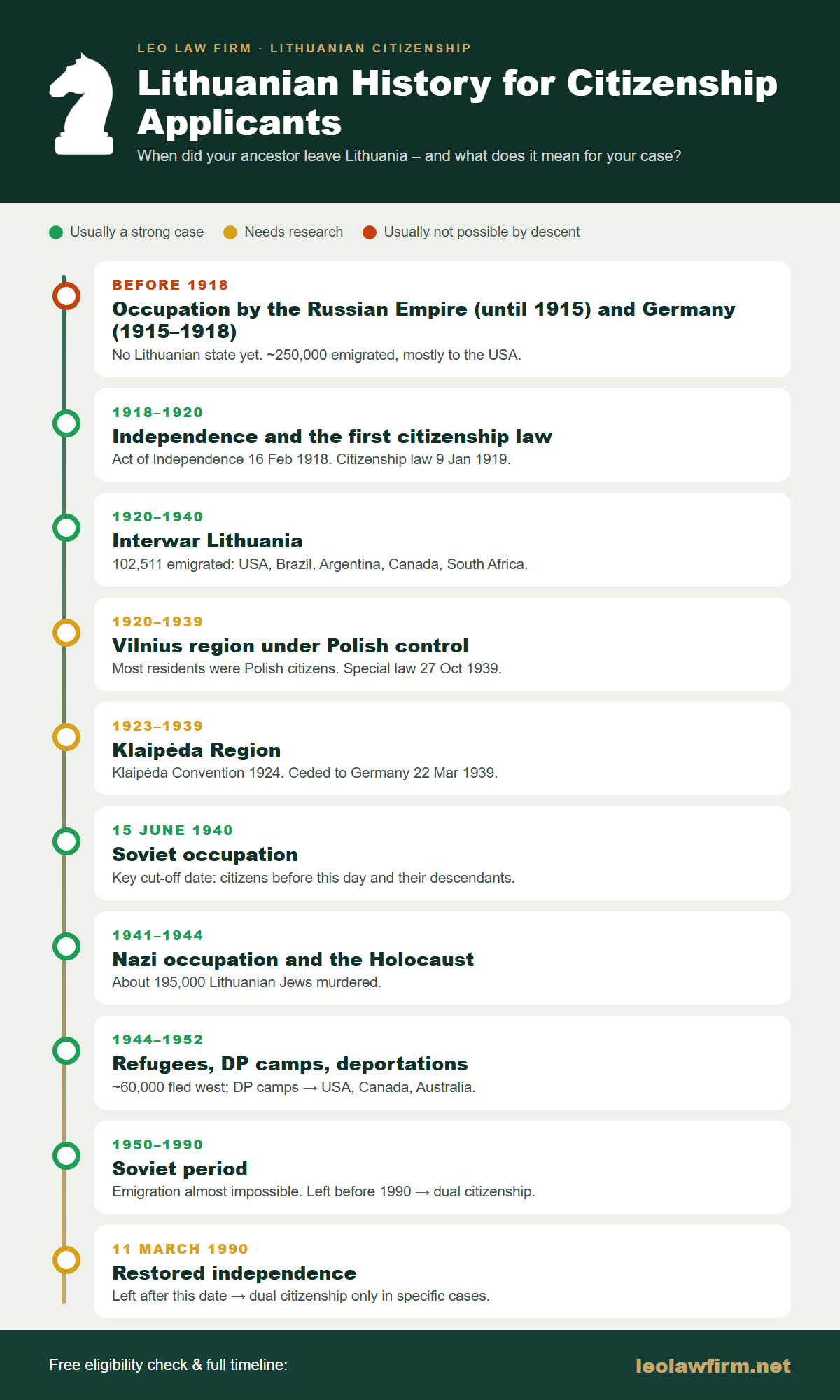
Infographic: Lithuanian History for Citizenship Applicants
You may share this infographic on your website, blog or forum – free of charge, provided you keep the link to the source.
Not Sure Which Period Applies to Your Family?
Take our free eligibility check or book a free 15-minute consultation. Tell us when and from where your ancestor left Lithuania, and we will tell you which documents to look for.